

Another deep dive: reconstructing major incidents from the primary record is part of what we do for banks, regulators and law enforcement.
Evidence cut-off: 30 October 2026, 21:30 UTC, about 25 hours after the first outflow. Status: preliminary. Binance has not published its root-cause report, no government has attributed the attack, and most stolen value has not yet moved to a cash-out point.
Grades used throughout: Confirmed = on-chain record, or two independent primary sources. Probable = one strong source, consistent with the rest. Unverified = a single weak source, or inference not yet tested. Not supported = checked, and contradicted or without basis. All times are UTC. Dollar values are at prices when taken unless stated; where firms disagree, the figure used is named with its source and snapshot time.
Executive summary
Between 20:05 and 23:56 UTC on 29 October 2026, an attacker made Binance’s own hot-wallet signing infrastructure sign transfers to attacker addresses on ten blockchains and took about $6.36bn at prices when taken (TRM Labs; other counts are in Appendix D). It is the largest theft of any kind on record: four times Bybit’s $1.46bn in February 2025, and more than twice the $2.87bn stolen in roughly 150 crypto hacks across all of 2025. No private key is known to have left Binance. The keys signed what they were asked to sign.
Key judgments
1. The compromise sat upstream of the keys. Probable, strong. Seventeen hot wallets on ten chains, using different key types, produced valid attacker signatures within about 30 minutes, and on Ethereum the attacker obtained fifty authorizations, one per nonce, because it could not predict which would be live. Both point to control of the service that requests signatures. Binance’s own account has shifted three times since its first version and names no root cause.
2. EIP-7702 was the instrument on Ethereum, used exactly as specified. Confirmed. Fifty authorizations signed with the Binance 14 key turned one of Binance’s best-known hot wallets into a sweeper only the attacker could call. One call took about $2.53bn. The delegated wallet also carried its rights over a second Binance account, and Binance’s deposit systems kept feeding it for hours afterwards.
3. Containment came from the issuers, ahead of the victim. Confirmed. Tether froze the main receiving wallet at 21:01, 86 minutes before Binance suspended withdrawals. Elliptic verifies $2.84bn frozen on-chain, 94% of it USDT and USDC. Nothing on Bitcoin, the XRP Ledger, Solana or NEAR was frozen, because nothing there can be.
4. The attacker still controls about $3.2bn to $3.3bn that no issuer can touch. Confirmed, snapshot-dependent. The ETH position is two and a half times the ETH stolen: about $786m of stablecoins was dumped into ETH and TRX at a steep discount before the freezes landed. The Bitcoin, XRP and SOL have not moved since the first hour.
5. North Korea’s TraderTraitor is the probable perpetrator, on circumstantial evidence. Probable. TRM (”high confidence”) and Chainalysis name TraderTraitor; Elliptic says “likely” and “not yet certain”. The strongest public on-chain link, commingling with proceeds of the September Bitget theft, rests on about $39,000 of Binance funds at an address that may belong to a launderer serving several clients. No government has attributed the attack.
6. Binance’s pledge is credible in size and unverified in substance. Company statement. $6.34bn of company funds is reserved, several times what the SAFU fund holds. Withdrawals are targeted for Sunday 1 November and a proof-of-reserves report for Monday 2 November. If frozen stablecoins are reissued to Binance, the net economic loss falls to roughly $3.3bn to $3.7bn.
Corrected or unsupported
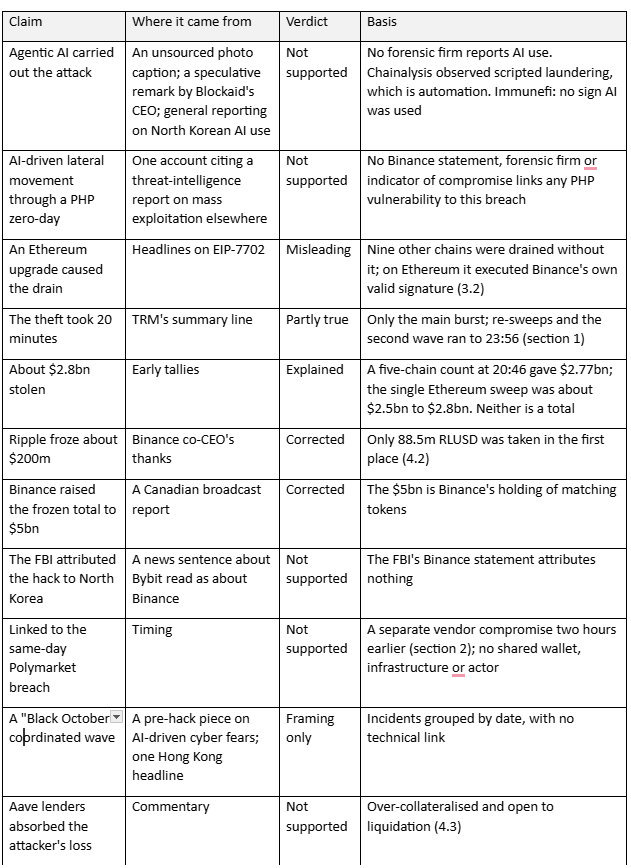
Agentic AI in the attack, an Ethereum protocol flaw, a link to the same-day Polymarket breach, a $200m Ripple freeze and a $5bn freeze total all fail on the record (section 8).
What decides the next chapter
Two answers decide the next chapter: how the attacker came to command Binance’s signers, which only Binance can give, and whether a government names North Korea, which turns every downstream exposure to these funds into a sanctions question.
1. What happened
The theft took 3 hours 51 minutes, was rehearsed for 36 hours before that, and was contained by everyone except the exchange it was taken from.
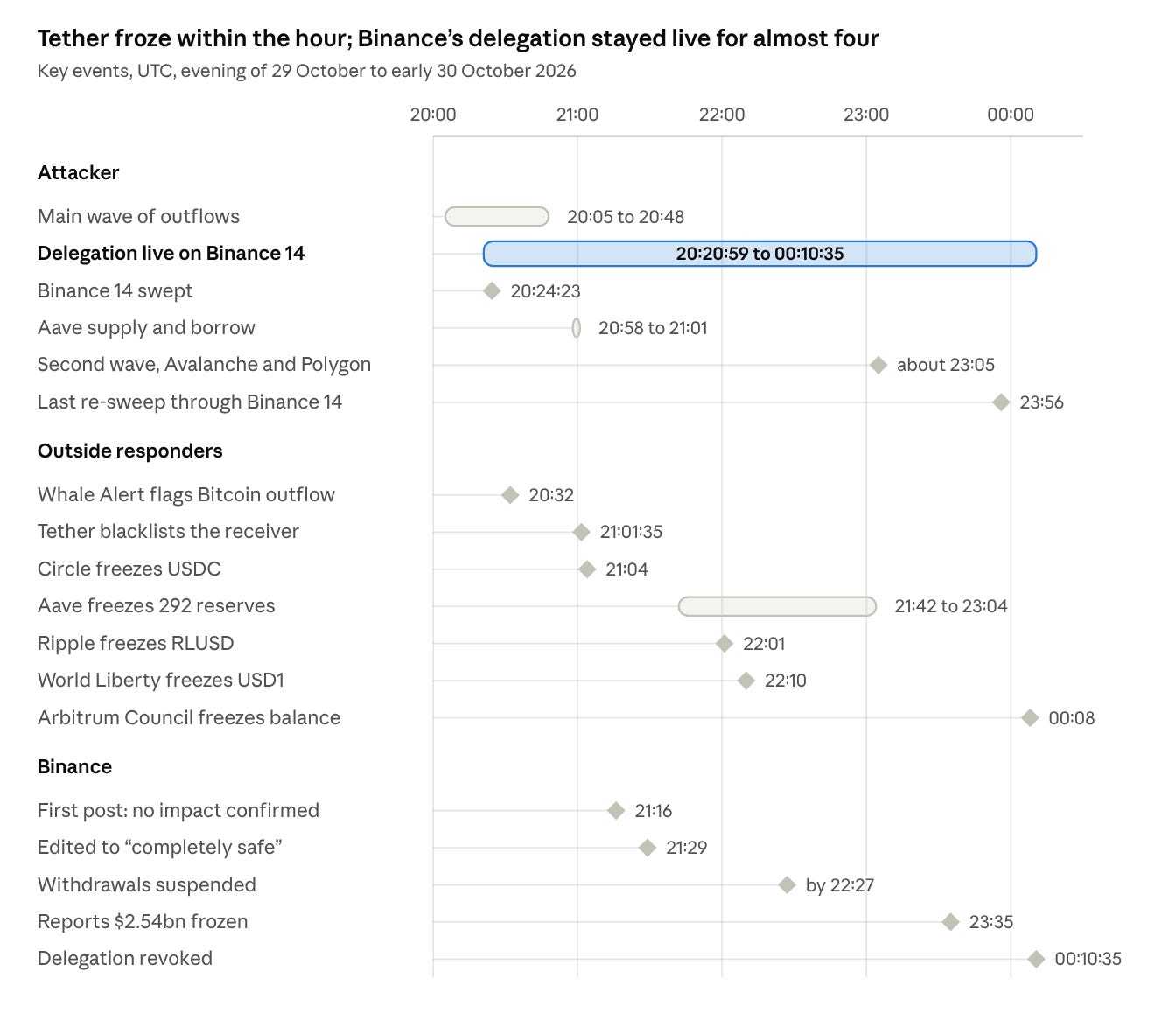
Section 2 timeline · 18 events, UTC
Every outside responder with a published time acted before Binance revoked its own delegation; the last of them, the Arbitrum Security Council, by about two minutes.
Preparation. The operator wallet (0x7C86…5CA0) was funded through Tornado Cash from the morning of 28 October. On 29 October it deployed a first sweeper, tested the sequence on two of its own wallets, rehearsed it on a third, and at 15:59 deployed the final sweeper, callable by the operator alone.
Execution. Nine chains paid out between 20:05 and 20:48, the XRP Ledger first: eight through ordinary signed transfers, Ethereum through a delegation installed at 20:20:59 and used three minutes later. Polygon and a second Avalanche wave followed around 23:05, and the captured Ethereum wallet kept forwarding customer deposits until 23:56.
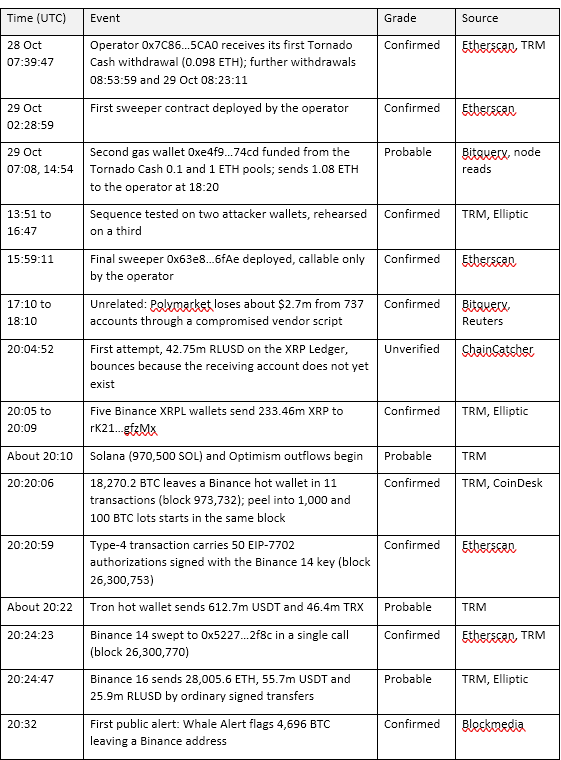
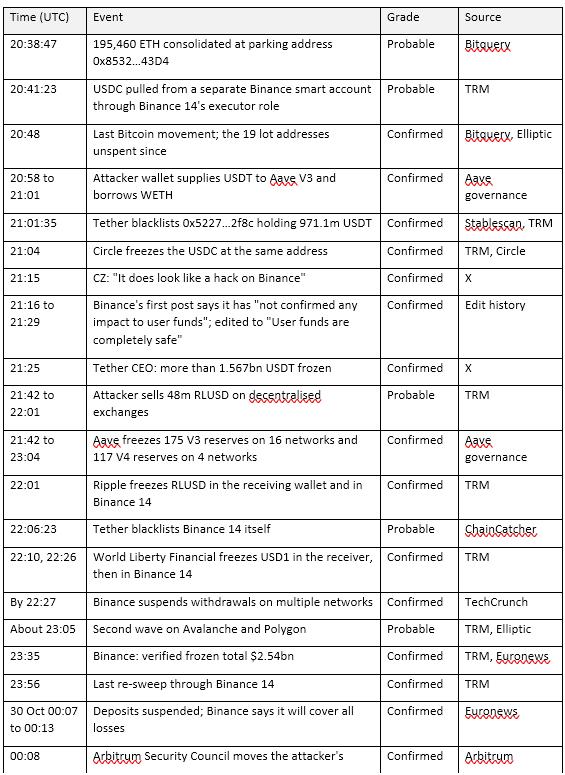
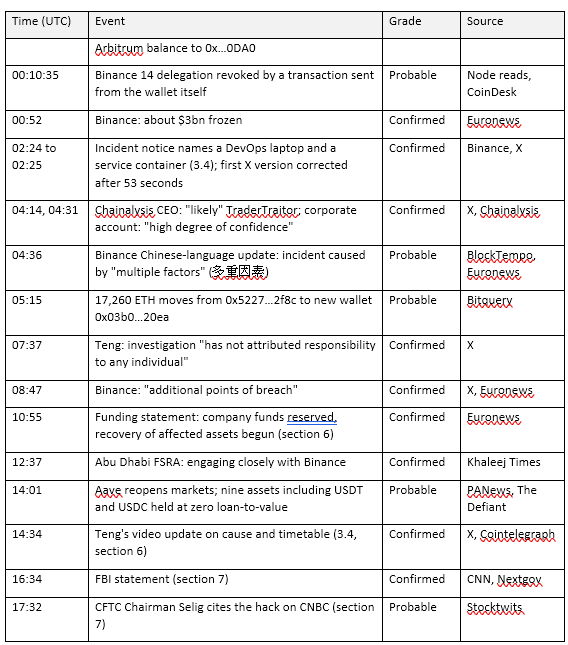
2. Verified timeline (UTC)
On-chain times come from block records or the named forensic firm; statement times from the post or the outlet that timed it.
3. Technical anatomy
The attacker controlled what Binance’s signers were asked to sign, on ten chains at once, and used one Ethereum feature to turn a single signature into a standing order.
3.1 The compromise sat in the signing request path
Seventeen Binance hot wallets paid the attacker (Bitquery). On nine chains, and from a second Ethereum hot wallet, they did it through ordinary signed transfers: nine transfers worth $174m from Binance 16 alone (Elliptic). These wallets span at least two signature algorithms (secp256k1 ECDSA and Ed25519) and separate key stores. All produced valid attacker signatures within about 30 minutes. A stolen key explains one wallet. A captured request path explains seventeen.
The Ethereum leg adds a second argument. The attacker submitted fifty pre-signed authorizations because it could not predict the wallet’s nonce at execution time. An attacker holding the Binance 14 key would have signed one authorization at the live nonce, seconds before sending it. TRM reads the batch the same way: the access was time-limited, or signatures had to be requested through a system. The revocation was later sent from Binance 14 itself, so Binance still held the key.
The dissent: Mark Karpeles said the attackers “probably accessed private keys for at least two Binance wallets”, and SlowMist’s CISO lists key leakage as an open hypothesis. Both readings fit the on-chain record, which shows what was signed and never who asked. On current evidence the signing-path reading is the stronger one. Probable.
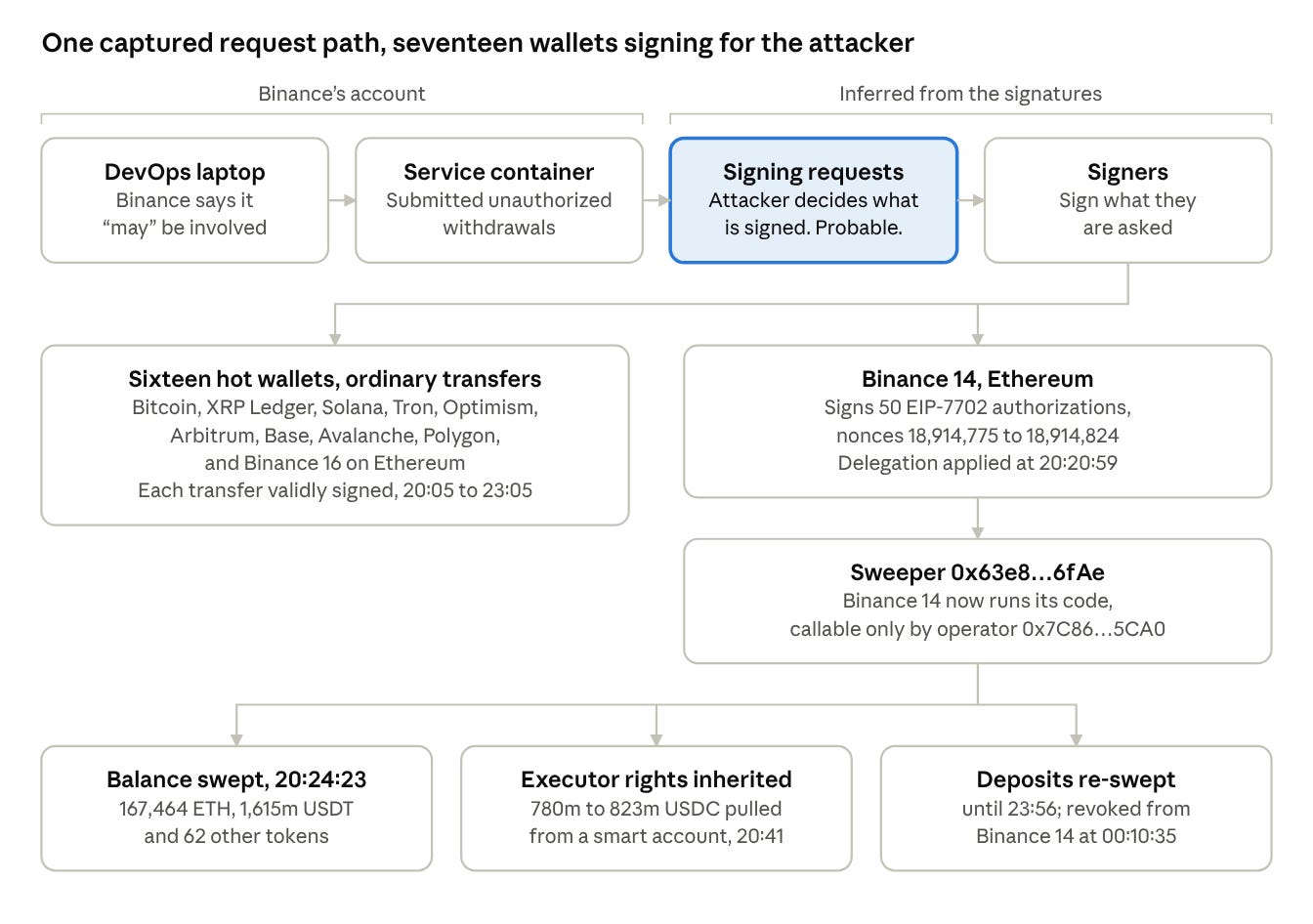
Attack path · Binance’s account and the on-chain record
Binance has not said how the container reached the signing requests. That link is the missing step between the two halves of the picture.
3.2 Ethereum: how one signature became a standing order
EIP-7702, live since the Pectra upgrade in May 2025, lets an ordinary wallet hand its behaviour to a contract by signing an authorization naming the chain, the contract and the wallet’s nonce. The delegation stays until the wallet signs another.
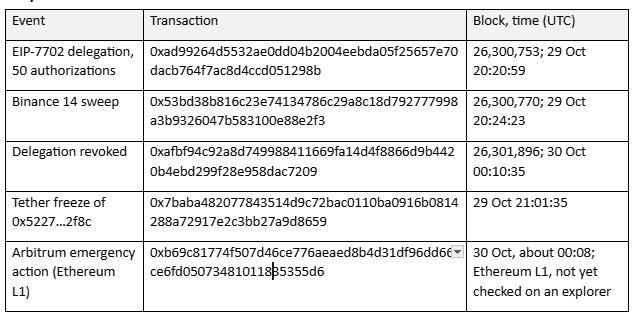
1. The spray. At 20:20:59, one type-4 transaction carried fifty authorizations, one for each nonce from 18,914,775 to 18,914,824, all pointing Binance 14 at the sweeper 0x63e8…6fAe. The first tuple matching the live nonce took effect. Each applied authorization advances the nonce, so later tuples in the ascending list re-applied the same delegation. The result was one delegation.
2. The sweep. Three minutes 24 seconds later, the operator called the wallet once: 167,464.25 ETH, 1,615.4m USDT and 62 other tokens, about $2.53bn, two thirds of everything taken on Ethereum.
3. The standing order. Binance’s deposit systems kept consolidating customer funds into Binance 14. The operator swept them again at 20:41, 20:59, 21:04, 21:44, 22:39 and 23:56.
4. Inherited authority. Binance 14 was the executor of a separate Binance smart account. Delegated code runs with every role, allowance and executor right other contracts have granted the address, so the attacker could pull about 823m USDC from that account at 20:41 (TRM). Circle froze it shortly after.
5. Sealing from outside. Ripple froze RLUSD inside Binance 14 at 22:01, Tether blacklisted the wallet at 22:06 and World Liberty Financial froze USD1 in it at 22:26. From then on the standing order could collect only what no issuer controls.
Nothing in Ethereum failed. The protocol executed a valid signature from the wallet’s own key, exactly as the specification describes and warns.
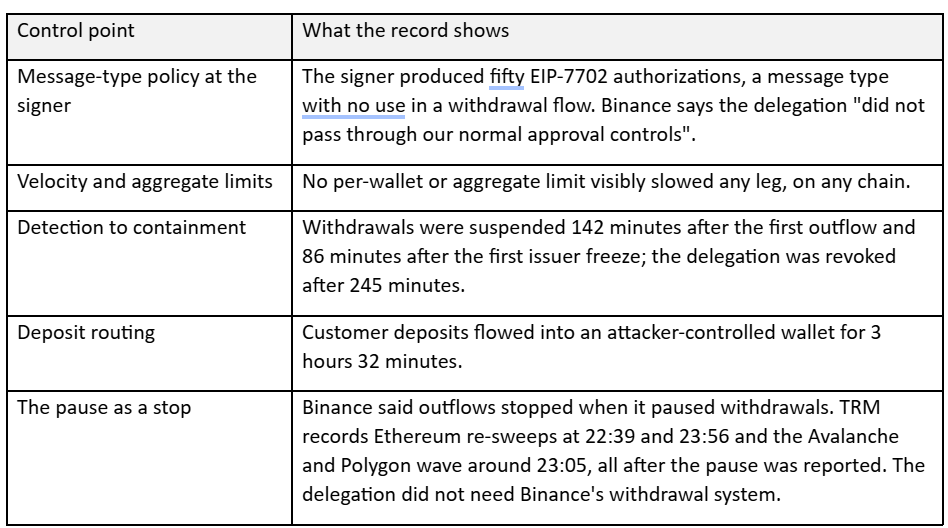
3.3 Controls that did not fire
Binance has published nothing on its control environment. The on-chain record still shows five control points that either did not exist or did not trigger. Analysis.
3.4 The entry route: what Binance has said, and what is missing
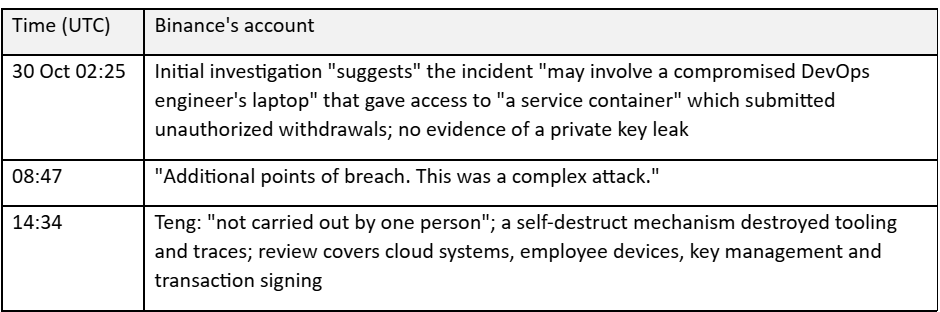
The precedents point to people. On 27 October Binance said it had blocked several North Korea-linked attacks in the previous week, reportedly the “Contagious Interview” fake-recruiter campaign; no source links that campaign to this breach. In the 2024 DMM Bitcoin theft, TraderTraitor posed as a recruiter to an employee of the wallet-software provider Ginco.
Two phrases need the post-mortem. “Not carried out by one person” can mean several operators or several access paths; nothing published indicates an insider. A “self-destruct mechanism” cannot mean the EVM opcode in its old form: since EIP-6780 (March 2024) it deletes code only for contracts created in the same transaction. Deletion of off-chain tooling is the likelier meaning. Both: Unverified.
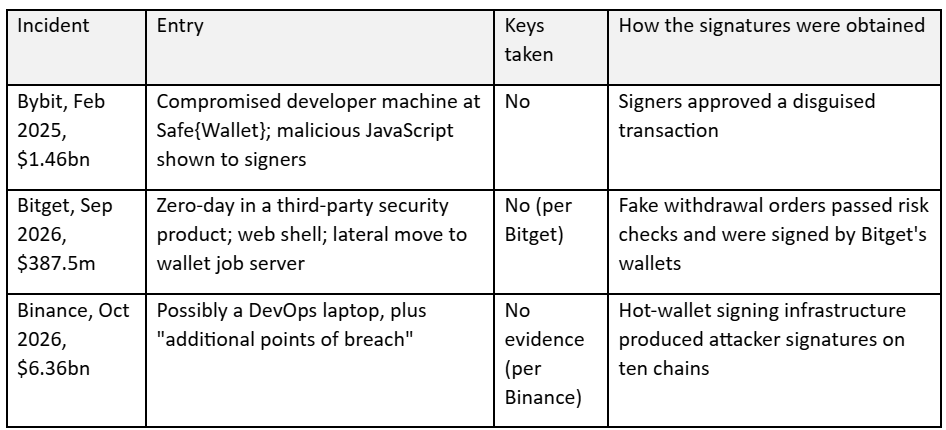
3.5 Three exchange thefts, one pattern
4. Fund flows
The freezes split the theft along one line: assets with an issuer were caught, assets without one were not.
4.1 What left, chain by chain
TRM values each transfer at the moment it was taken; its per-chain figures sum to the $6.36bn total. Native amounts are below; addresses are in Appendix A.
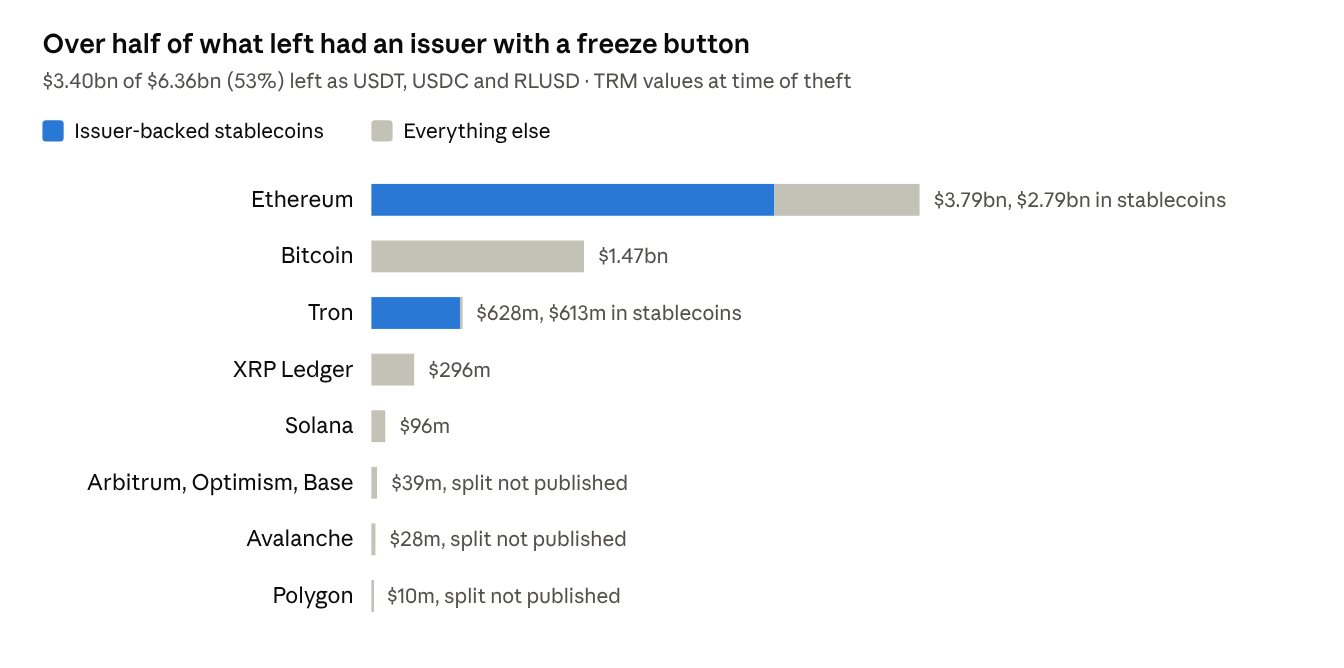
TRM per-chain values at time of theft; stablecoin amounts from the table below
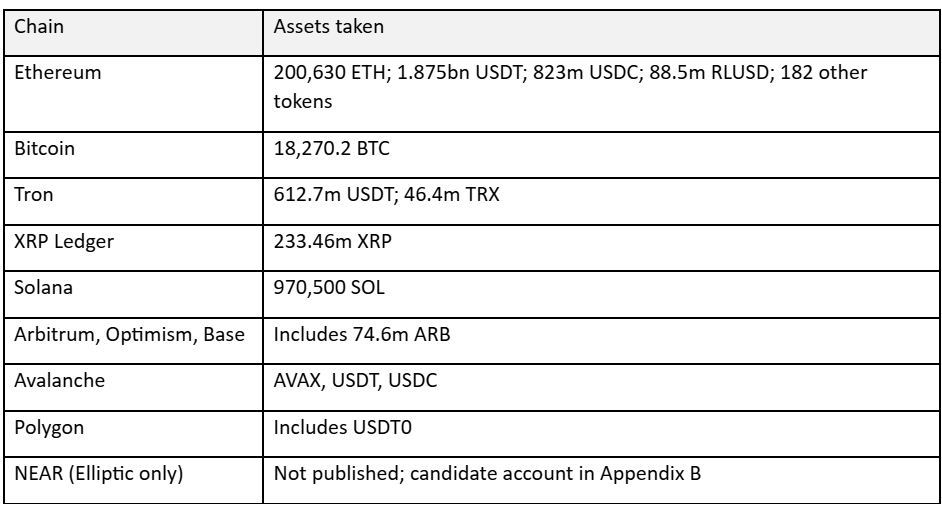
4.2 The freeze race
The stablecoins sat in the receiving wallets for 37 minutes on Ethereum and 46 on Tron. The issuers used the window.
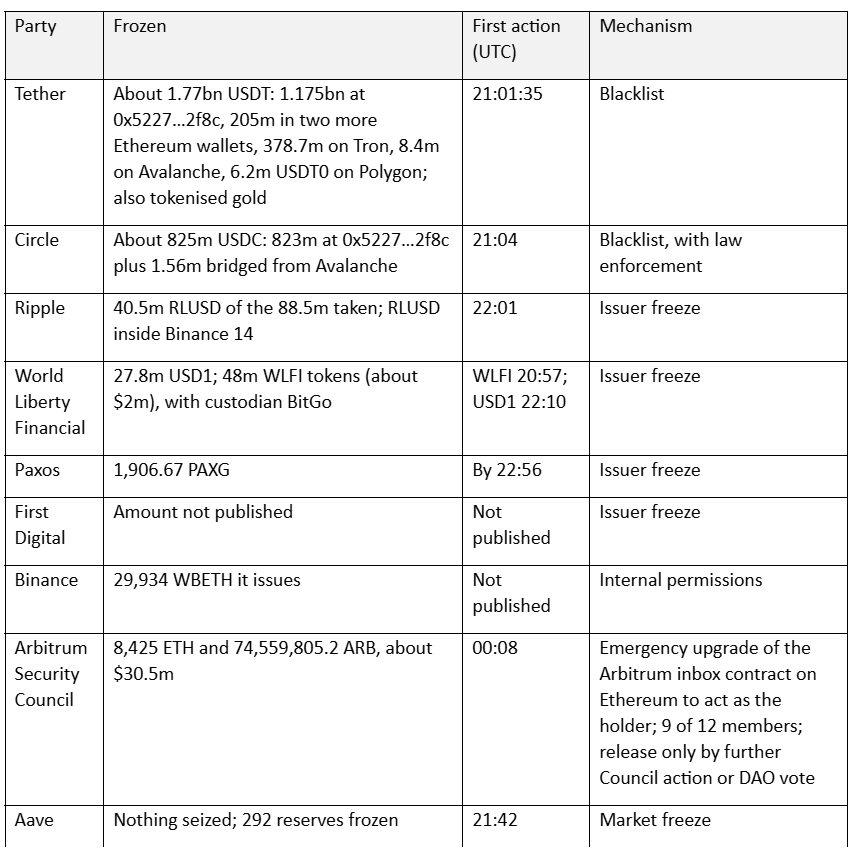
The verified total is $2.84bn (Elliptic, about 07:00). Earlier and broader figures are snapshots on other bases, logged in Appendix D. A freeze immobilises tokens at an address; none of it has been publicly returned to Binance yet.
4.3 How the attacker raced the freezes
• Stablecoins into ETH, at any price. About $786m was converted into ETH and TRX before the freezes landed (Elliptic). TRM saw 325m USDT sold to professional fillers and market makers through UniswapX and intent-based contracts for about 122,300 ETH, an implied $2,650 per ETH with the market at $2,300 to $2,350. Elliptic counts 434m USDT for 160,451 ETH across Uniswap, 1inch and request-for-quote desks, 12% to 26% below market. Market makers bought stolen USDT minutes after it was stolen.
• Aave as an exit. Between 20:58 and 21:01 one wallet supplied 59.9m USDT and borrowed 19,762 WETH, about $44.6m. The position is about 137% collateralised and open to normal liquidation. The attacker left freezable stablecoins in Aave and walked away with unfreezable ETH. Aave’s own GHO stablecoin briefly touched $0.997.
• Tron. 300m USDT went to a wallet supplying the JustLend lending protocol; 200m moved through hop wallets (30m frozen); 234m was swapped for 638m TRX on SunSwap. Since 02:45 on 30 October, TRX has been split into lots and swapped back to USDT. Chainalysis sees thousands of addresses each first funded with exactly 1 TRX: laundering run by script.
• Token dumps. Seven tokens sold for 70,480 ETH (about $158m), 3.38bn RSR for 1,856 ETH, around 150 smaller tokens for ETH, and 48m RLUSD on decentralised exchanges.
• Cross-chain. Almost none so far. About $1.9m of TRX left through a peel chain of roughly 28 hops, THORChain and the Hyperlane bridge; part of it reached the address shared with Bitget proceeds (section 5). Avalanche proceeds were bridged as USDC through Circle’s CCTP and frozen four minutes later.
• Costs. Bitquery estimates about $119m lost to slippage and about $60m captured by arbitrageurs: the largest theft on record also paid the MEV bots. Single source.
No exchange cash-out, mixer deposit or OTC hand-off had been confirmed at the cut-off. No source traced funds to Southeast Asian networks such as Huione or its successor H-Pay, or to Garantex successors.
4.4 What the attacker holds now
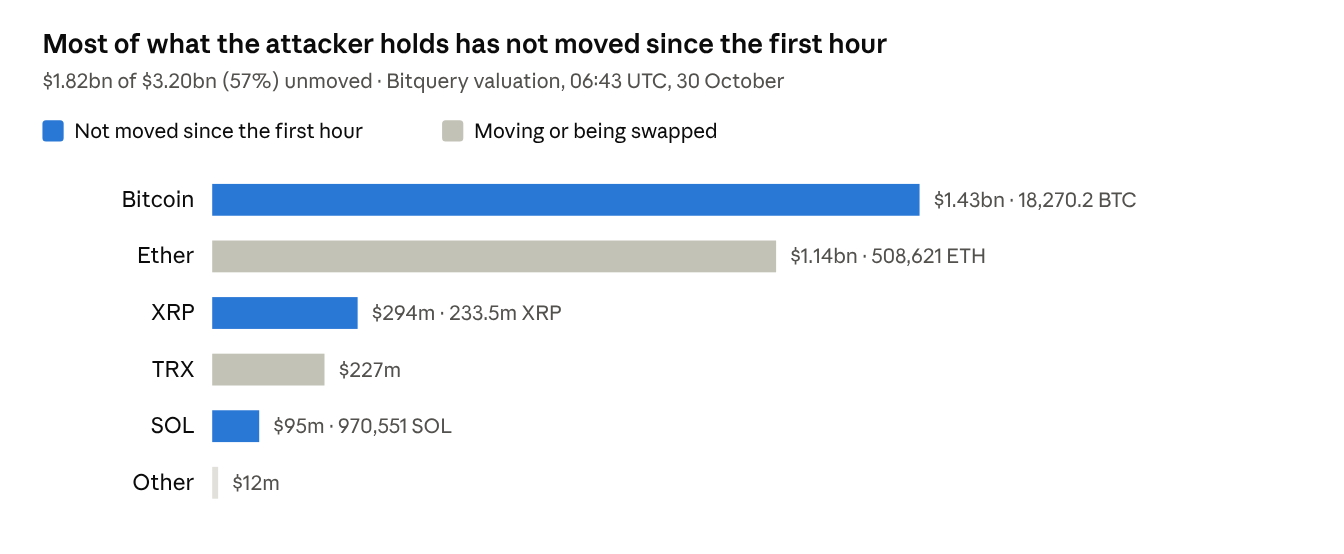
Bitquery holdings snapshot, 06:43 UTC, 30 October
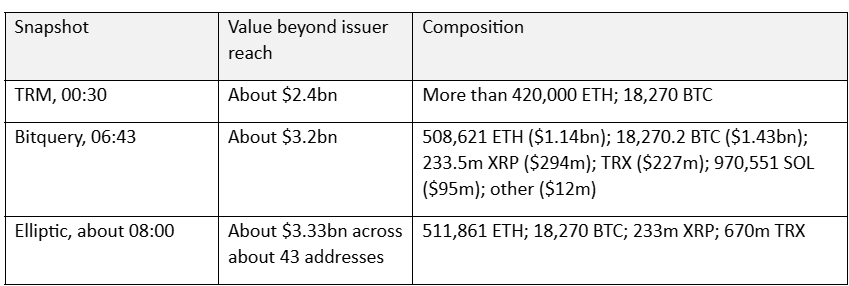
The XRP sits in one address that only an exchange can stop.
4.5 A pre-hack lead
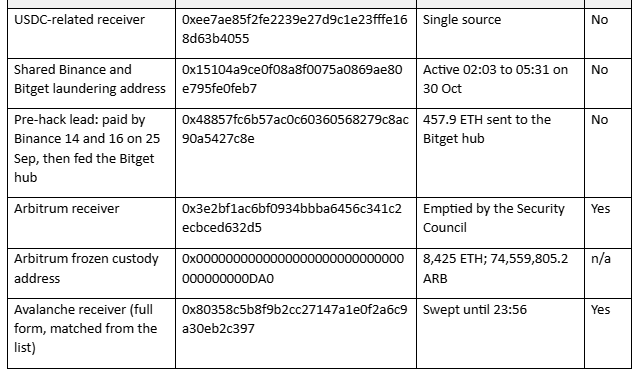
Address 0x4885…7c8e received payouts from Binance 14 and Binance 16 on 25 September, then sent 457.9 ETH to the hub that collected the Bitget theft (Bitquery). Payouts from Binance hot wallets are customer withdrawals, so a Binance account sits behind that address, or a service used by both thefts does. Binance can answer this from its own records. Unverified lead.
5. Attribution assessment
North Korea’s TraderTraitor is the probable perpetrator. Two leading forensic firms say so with high confidence and the tradecraft fits, but the public evidence is circumstantial, part of TRM’s basis is undisclosed, and neither Binance nor any government has attributed the attack.
5.1 Who says what
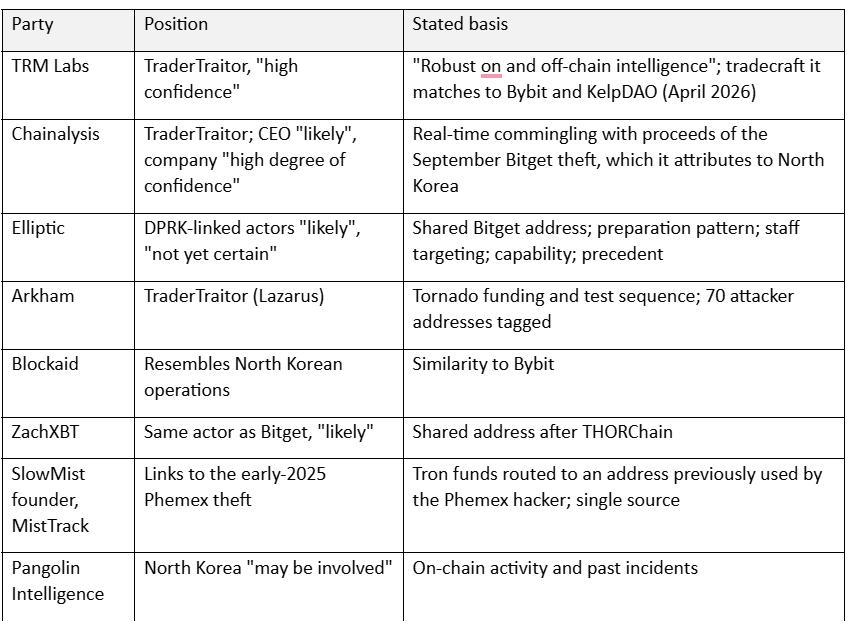
5.2 Evidence for
• Tradecraft. Tornado-funded staging, rehearsal on test wallets and pre-obtained signatures fired in one burst.
• Target choice. Bybit, the closest precedent in 3.5, was attributed to TraderTraitor by the FBI within five days.
• Shared address. Binance and Bitget proceeds met at 0x1510…eb7 after THORChain hops, from 04:02 on 30 October; Chainalysis, ZachXBT and Elliptic observed it independently.
• Social engineering of staff. The recruiter campaign Binance reported blocking on 27 October (3.4) is a known TraderTraitor entry route.
• Capability. Few actors can run the operation described in section 3.
5.3 Evidence against, or missing
• The overlap is small. About $39,000 (13.63 ETH) of Binance-linked funds against about $510,000 (349.46 ETH) of Bitget-linked funds. A shared address proves a shared laundering network, which professional launderers sell to several clients.
• The laundering was slow. North Korean operators usually swap stablecoins for native assets within minutes. Here more than $2.6bn of stablecoins was still in attacker wallets when the issuers froze them.
• The laundering was different. Market makers and lending protocols, not the bridge-heavy pattern after Bybit (TRM’s own observation).
• The Bybit match is asserted, not shown. The features TRM lists do not appear in TRM’s 2025 Bybit posts or in the FBI’s Bybit alert.
• Bitget’s own attribution is soft. Chainalysis and Elliptic call it North Korean; TRM has not definitively attributed it.
• No government statement. Nothing from the FBI, OFAC or South Korea names a perpetrator (section 7).
5.4 Grading
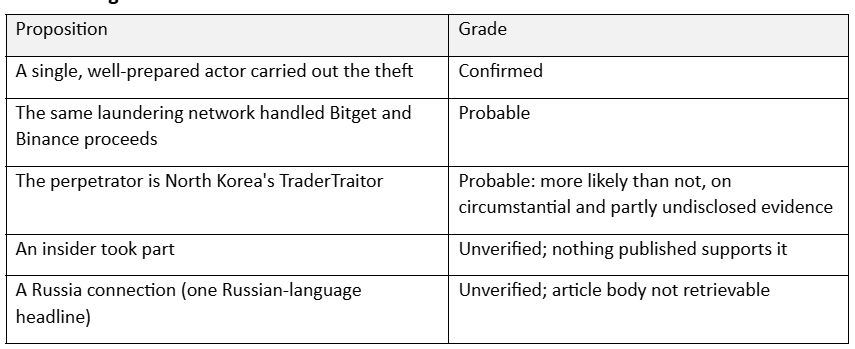
What would settle it: an FBI public service announcement, an OFAC designation of attacker addresses, a South Korean government statement, or a forensic firm publishing address-level overlap with wallets from attributed thefts. If the attribution holds, this one theft roughly doubles the more than $6.5bn Elliptic estimates North Korea-linked actors have stolen in recent years, and the US government ties those proceeds to the weapons programme.
6. Binance’s account and how it changed
The size of the loss held from the first estimate. The cause, the scope of the suspension and the funding of the pledge each changed within twelve hours. The entry-route statements are in section 3.4.
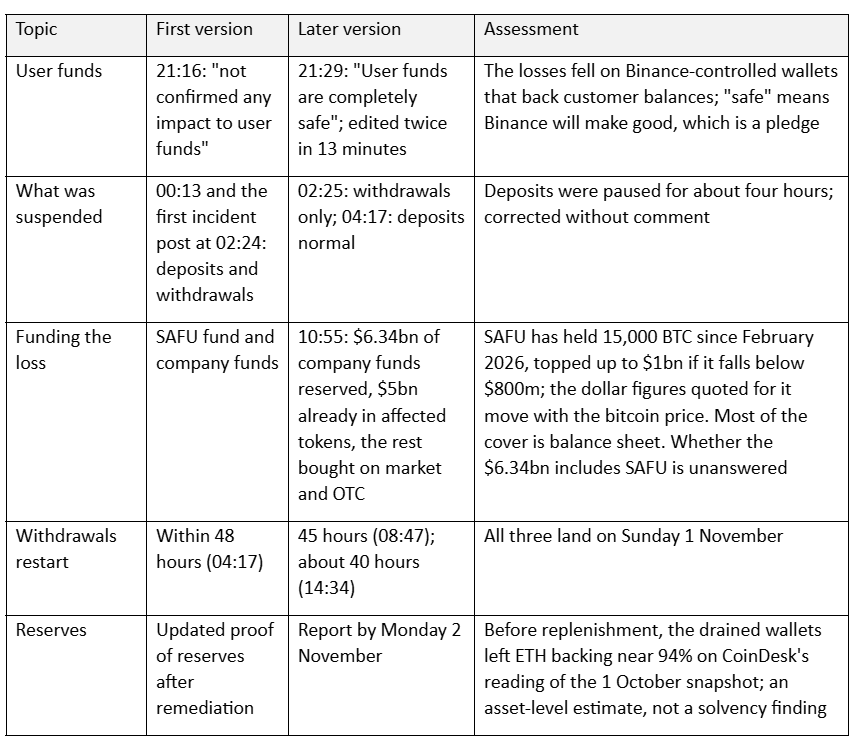
7. Official, law-enforcement and regulatory record
Three public authorities have spoken: the FBI, Abu Dhabi’s FSRA and the CFTC chairman. None has attributed the attack or announced a measure against Binance.
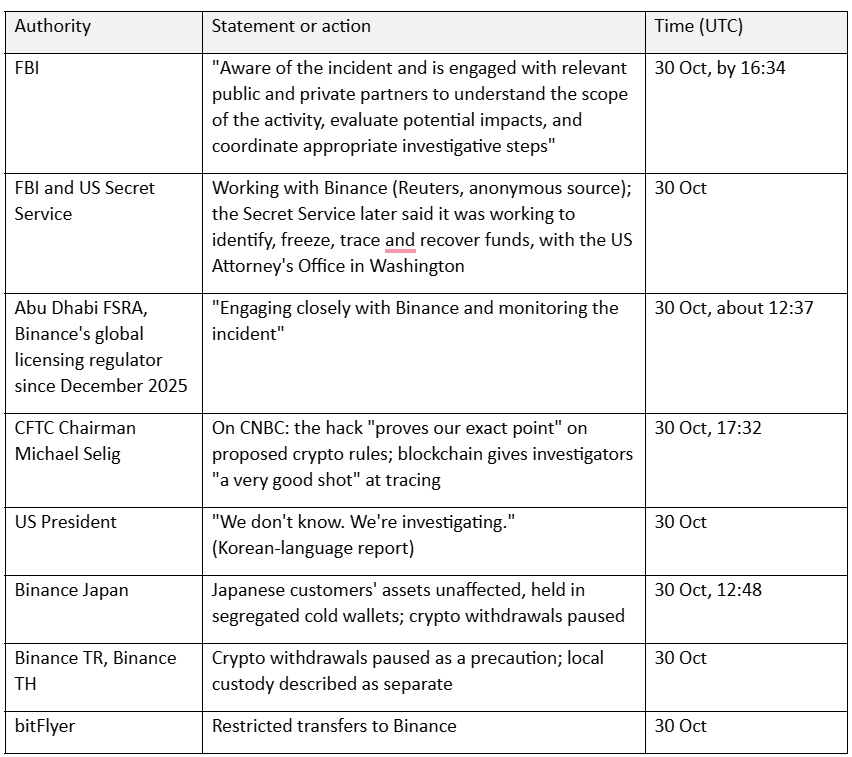
Searched, nothing found at the cut-off: IC3 or FBI public service announcement; DOJ; Treasury and OFAC; CISA; South Korea’s NIS, police and foreign ministry; Japan’s FSA and NPA; ESMA, the European Commission and the ECB; BaFin, AMF, CySEC and Greece’s HCMC; UK FCA; SEC; Dubai VARA; Turkey’s SPK and MASAK; India’s FIU; Europol and Interpol. No lawsuit over the hack was found.
Context that shapes the response
• European Union. Binance holds no MiCA authorisation. It withdrew its Greek application in June 2026, and since 1 July EU users can only withdraw, sell or close positions. The Wall Street Journal reported in September that ECB President Lagarde intervened against the licence; Binance disputed the account.
• United States. The DOJ was reported in October to be examining whether Binance breached its 2023 plea agreement through Iran-linked trading; the SDNY filed a civil forfeiture complaint over about $61m on 14 September. Senator Blumenthal questioned early termination of Binance’s monitorship in April. CZ was pardoned in October 2025. No link between any of this and the hack has been made.
• OFAC, 28 October. The day before the theft, Treasury designated Russians and North Koreans supporting DPRK IT-worker fraud. No connection to Binance is stated.
• Abu Dhabi. A Binance spokesperson says Binance reports weekly to the FSRA on the funds set aside. How the FSRA handles an incident of this size will define what its global licence means in practice.
• The MiCA yardstick. For an EU-authorised custodian, Article 75(8) of MiCA makes the CASP liable to clients for crypto-assets lost through an incident attributable to it, capped at market value at the time of loss. Binance has volunteered roughly that outcome without being bound by it. EU supervisors will read this incident into every custody and ICT-risk review they run this winter.
8. Claims tested
Most first-day claims about scale survived. Most claims about cause, method and connection did not.

9. Analysis: what this incident changes
Custody security has been measured by where the keys live. Three of the largest exchange thefts in twenty months left the keys where they were and corrupted the instruction to use them. That moves the unit of risk from the key to the authorization path.
1. The signer needs its own judgment. HSMs, MPC and key ceremonies defend a door this attacker never touched. The controls that would have mattered sit between the request and the signature: a signer that refuses message types it has no business signing (an EIP-7702 authorization, a token approval, a contract upgrade); separate policy engines per chain and per wallet tier, so one compromised orchestrator cannot speak for seventeen wallets; aggregate velocity limits measured across chains, since the theft moved in a pattern no single-wallet limit would see; and a pre-signed, tested revocation for every EOA, so the fix takes a block and not four hours.
2. Treat a delegation as an administrator-key event. Any institution holding funds in Ethereum EOAs should alert on code appearing at an address that should have none, and inventory what each hot address is entitled to elsewhere. The blast radius of a captured EOA is everything the address has been trusted with.
3. The recovery layer is centralised, and it worked. Token issuers and a governance council did the containing, the council by temporarily upgrading a bridge contract to act as the holder. The policy debate about issuer freeze powers now has its largest data point, and it cuts both ways: the power that contained this theft also showed who can move funds without the holder’s key.
4. Liquidity venues are laundering rails until they screen at fill. Solvers, market makers and a lending market took stolen USDT within minutes (4.3). Counterparty screening at the moment of the fill now belongs on the front line of anti-laundering controls.
5. For counterparties, today’s question is operational. Binance’s balance sheet appears to absorb the loss; the withdrawal restart and the reserves report are the tests. Institutions with exposure should confirm which Binance entity holds their assets (section 7) and screen inbound flows against the attacker clusters now.
6. The attribution date changes the compliance question. Until a government names North Korea, exposure to these funds is stolen-property risk. After an FBI statement or OFAC designation, the same exposure becomes sanctions risk, with the strict-liability regime that comes with it. Desks, banks and CASPs that touch the attacker clusters between now and then should document their screening as if that day has already come.
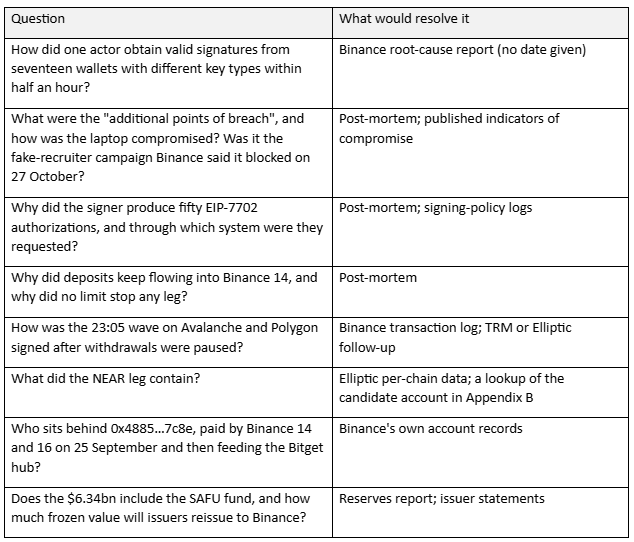
10. Open questions and watchlist
The next 72 hours answer the operational questions; the attribution and the money trail will take months, as Bybit’s did.
Open questions
Watchlist
• ☐ Binance withdrawal restart, targeted for Sunday 1 November
• ☐ Binance proof-of-reserves report, due Monday 2 November
• ☐ Binance technical post-mortem
• ☐ First movement of the Bitcoin lots, the XRP or the SOL (Appendix A)
• ☐ Movement from the ETH parking and stash wallets (0x8532…43D4, 0xc887…286a, 0x897c…8df3)
• ☐ TRX lots from the Tron splitter reaching an exchange or OTC desk
• ☐ New activity at the shared Bitget address 0x1510…eb7
• ☐ Government attribution: FBI, OFAC or South Korea (5.4)
• ☐ Arbitrum DAO vote on releasing the frozen ETH and ARB
• ☐ Tether, Circle or Ripple reissuing frozen value to Binance
• ☐ Aave restoring loan-to-value on the nine assets held at zero
• ☐ Any statement from ESMA, the FCA, the SEC or the FSRA beyond monitoring; any lawsuit
The next stage of this case is our day job
The theft now moves from the chain to the casework: tracing, screening, attribution and supervisory follow-up. Cointegrity works there. Our head of governance, risk and compliance sits on the executive committee of the Global Coalition to Fight Financial Crime, chairs its Digital Assets Task Force and co-leads its Attribution Center. He serves as a virtual-asset expert for the OSCE and UNODC, has supported more than 40 countries with government training and legislative reviews, and contributed to Europol’s public-private typology work on crypto assets.
For banks, CASPs and supervisors, we turn that into practice: exposure screening against attacker clusters, independent reviews of signing and approval controls, and investigation support alongside INTERPOL, Europol and national cybercrime units. cointegrity.io
Appendix A. Address and transaction register
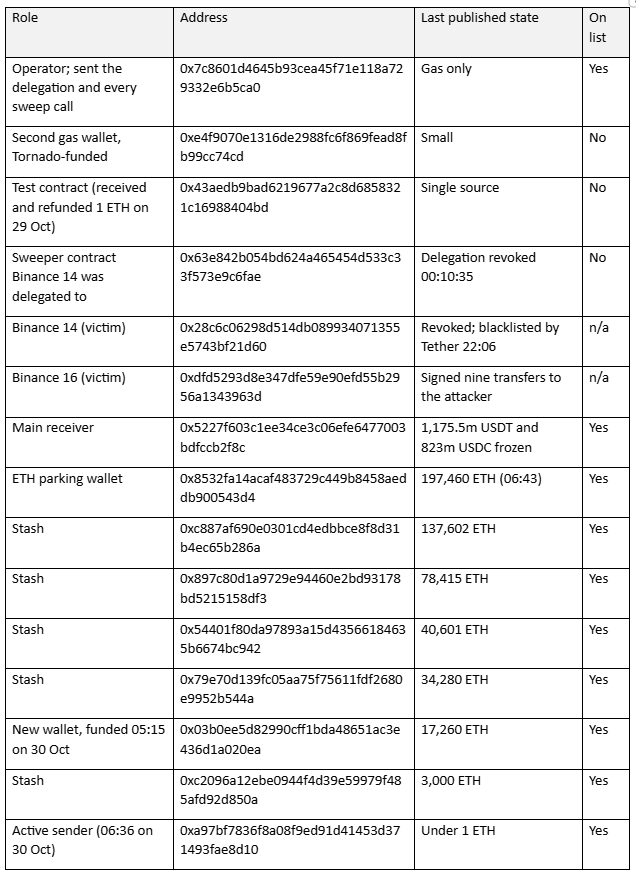
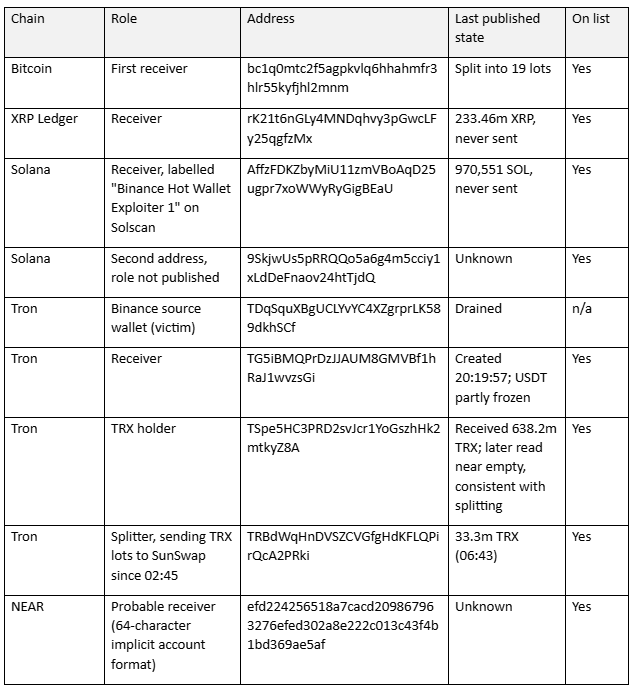
Addresses as published by the forensic firms and checked against the Elliptic blocklist snapshot of 30 October (Appendix B). “On list” means present in that snapshot. Balances are the latest published; they move.
Ethereum and EVM addresses
Key transactions
Other chains
The 19 Bitcoin lots
Unspent since 20:48 UTC on 29 October; lots 1 to 17 hold 1,000 BTC each. All 19 are on the Elliptic list.
lot,address,btc
1,bc1qxrxujwxfnvz040jw76d26zhjdg5jura7hs968s,1000
2,bc1qepc70u3u476vgvg3hfcwjgu4mecxe2uchs4lag,1000
3,bc1qdfhmlrdvg4tm87zjl0vyf0xflp5ql50q3g88gw,1000
4,bc1qnq6jj9jmlf3945m3l8s0kxnqehrsga300k8t3s,1000
5,bc1qz8hdwv8gmml0u96dsvnzsagz6krjyzxmgxupdp,1000
6,bc1q42flhayrzy3zh8lkyevw8qcjduurt9a35wlsyx,1000
7,bc1q63qrfrpsg5hh0zzn3kp2xx9vljl7dq7tatsjxp,1000
8,bc1q0ts8gaf9ht0rr4u02hr56f8thndqsc4kmkmfv3,1000
9,bc1q2wvz0kcsn4hqmajwtey30ud27fl25w8pveznn6,1000
10,bc1qalwnl7dtaa73fsq5tyn0ghfy3fgfpqkt69tca8,1000
11,bc1qjwdw6vrzq4vf6hckutvx4ucj86awwv99mxnz7w,1000
12,bc1qs3aej5tmcdz0vctz8y9rjcxtxg8v5385577s56,1000
13,bc1qm2j6v3247khlwzxl7p9vqnfkghcllyhv9wjaat,1000
14,bc1qs6xnmhar38z44g2za93pv8ygdcwurrh8l87w3v,1000
15,bc1qf5cyvv9w50tx9xx9s3xwsne0z87wvjj9l8a35u,1000
16,bc1qg3nrzpuvq2pxqx74tcrywr09dc208ze96n3t53,1000
17,bc1qm8v88m5fy6kuq9myva2eemwycxqd3e0zcrs2l8,1000
18,bc1qrg025e2pgx0rwya2kpgtj30972p64jt0hn6zyt,832.5
19,bc1qxg0l4p6xc50zuv9cl5f0l0wmaxjpg8wcy7s9ra,437.7
Appendix B. The Elliptic blocklist, decoded
Elliptic’s free screening list, retrieved on 30 October, holds 662 strings. Elliptic’s page advertised 48 addresses. Normalised and classified by address format, the list is a map of the laundering machinery as much as of the theft.
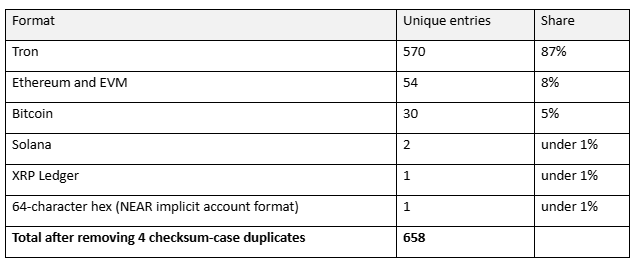
What the list adds
• The Tron layering network. 570 Tron addresses, 87% of the list, fit the scripted 1-TRX pattern in 4.3. The advertised 48 addresses are the theft; the other 600 are the laundering.
• The Avalanche receiver in full. Published elsewhere only as 0x8035…c397, it resolves to 0x80358c5b8f9b2cc27147a1e0f2a6c9a30eb2c397.
• A probable NEAR account. One entry is a 64-character lowercase hex string, the format of a NEAR implicit account and of a Bitcoin transaction hash. Elliptic is the only firm counting NEAR as an affected chain, and no NEAR address has been published anywhere else. Probable NEAR receiver; check on a NEAR explorer before relying on it.
• A second Solana address, 9Skjw…TjdQ, not reported by any other source.
• The full Bitcoin picture. All 19 lots are present, plus the first receiver and ten further Bitcoin addresses of undisclosed role.
What the list leaves out, and why that matters
The operator’s second gas wallet, the test contract, the sweeper contract, the USDC-related receiver and the pre-hack lead address are absent. So is 0x1510…eb7, the address shared with Bitget proceeds. Leaving the shared address off a screening list is consistent with Elliptic’s own caveat that it may belong to a launderer serving several clients: blocking it would flag unrelated users of the same service. Screening programmes should add it to a watch tier rather than a block tier.
The list is dynamic. Keep this snapshot dated and diff each new version against it.
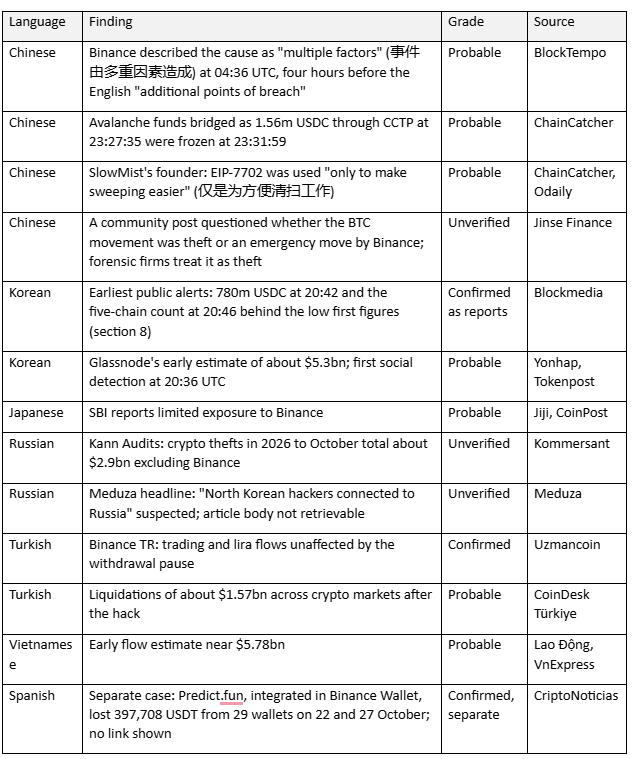
Appendix C. Findings from non-English sources
Most local coverage translated the wire. The findings below add a fact, a time or a correction not seen in English coverage.
Appendix D. Contradictions log
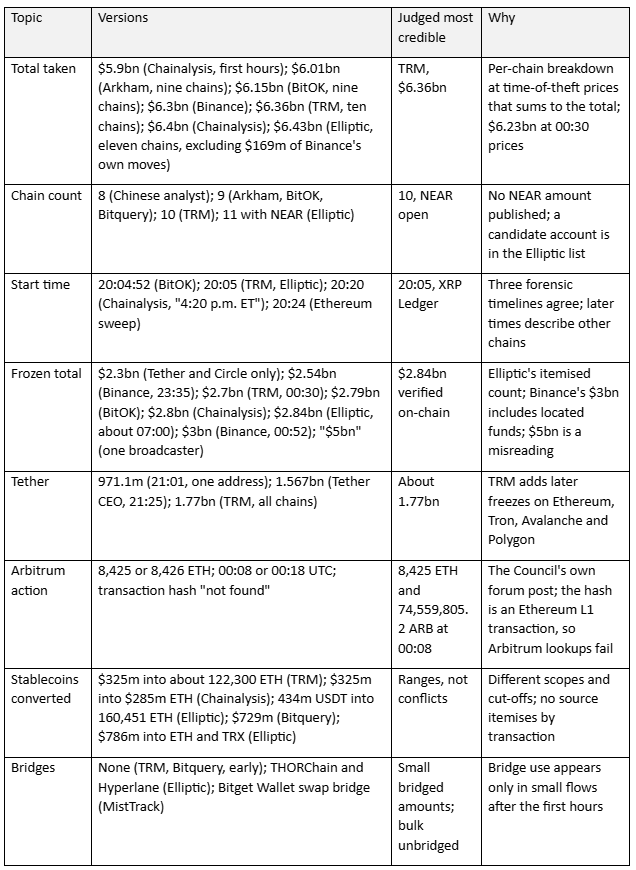
Most conflicts come from different cut-off times, valuation bases or chain scope. The two that matter are how the signing authority was obtained and how much is frozen.

Appendix E. Sources and method
Method. Every claim is graded on the scale at the top of this document. Where forensic firms disagree, the figure is named with its source and snapshot time and the conflict is logged in Appendix D. A claim with a single origin and no primary record behind it is graded Unverified or excluded. Addresses were cross-checked against the Elliptic blocklist snapshot. No closed forums, leaked data or login-gated sources were used. Not yet done: an independent explorer reconstruction of every chain, and archive captures of the executive posts, several of which were edited.
Read in full for this analysis (30 October, 21:00 to 21:40 UTC)
• TRM Labs: North Korea Steals USD 6.36 Billion From Binance in the Largest Hack in History (figures as of 00:30 UTC)
• Elliptic: The largest theft in history (version updated 08:00 UTC)
• Chainalysis: Binance Exploit, Latest Findings and Response (published 09:34 UTC)
Checked through search records
• Arbitrum: Security Council statement; forum notice with the 00:08 UTC time and custody address; FinanceFeeds on the inbox-contract mechanism; Namecoin News on the Ethereum L1 hash
• Aave: Tokenpost; Coin Gabbar on the governance update; Crypto Economy on GHO
• Law enforcement and statements: CNN, FBI statement; CBC; Cointelegraph live record; Bloomberg; NPR
• Context: Al Jazeera, with TRM’s 2025 theft total; Forbes on SAFU and custody assets; Wikipedia: Bitget theft; Crypto Times live record
• SAFU fund: Binance on the conversion to 15,000 BTC, 12 February 2026
Primary records cross-referenced
• On-chain: delegation transaction; sweep transaction; operator address; Tether freeze record
• Binance: incident notice; first post; initial findings; additional points of breach; Teng, no attribution; Teng, video update; CZ
• Issuers and attribution: Tether CEO; Circle CEO; Paxos; World Liberty Financial; Chainalysis attribution post
• Forensic: Bitquery; Arkham; Aave governance; Arbitrum forum post
• Official: Abu Dhabi FSRA; OFAC, 28 October; FBI on Bybit, 2025; Japan FSA on DMM Bitcoin, 2024; Senate letter on the monitorship
• Media: TechCrunch, withdrawal suspension; Nextgov, FBI; Khaleej Times, FSRA; CoinDesk, Bitcoin split; CoinDesk, reserve data; Stocktwits, CFTC chair; Reuters, Polymarket
Non-English: BlockTempo; Odaily; ChainCatcher; BlockWeeks; Blockmedia; Vedomosti; Kommersant; Uzmancoin; Koin Bülteni; WiWo; Nippon.com; The Standard; VnExpress; CriptoNoticias; Espreso